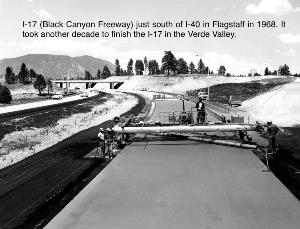
The Interstate 17 Black Canyon Freeway is a direct route from Phoenix to Flagstaff and Interstate 40 with a jog to the east it passes through Verde Valley and up the Mogollon Rim.
 But the path from Black Canyon stagecoach route to modern thoroughfare took a century and had as many twists and turns as the Apache Trail.
Difficult terrain, competing towns and routes, limited funding, the Great Depression and World War II all worked against completion of a highway and then an interstate directly to Arizona’s high country.
Started in 1956, the Black Canyon Freeway wasn’t finished in northern Arizona until August 1978, when the final 5.4-mile stretch from Copper Canyon to Montezuma Castle opened to traffic near Camp Verde. That was 40 years ago, when Arizona had 2.5 million residents, not today’s 7 million. Gas was about 71 cents per gallon, Space Invaders was a new video game craze and “Grease” was a summer movie hit.
You can use the slider above to compare the highway today heading north into the Verde Valley around 1969, when it was being upgraded to interstate freeway. And you can click on the photos at right to get more information on those parts of Interstate 17 construction.
 It was a busy summer for the Arizona Department of Transportation. In August, the Interstate 8 bridge over the Colorado River was dedicated in Yuma. A month later, a 67-mile stretch of I-40 from Kingman to Seligman was completed at a cost of $94 million. Plus, I-19 between Nogales and Tucson was nearing the finish line.
A century earlier, the first iteration of a Black Canyon route was scratched out north of Phoenix. In March 1878, the first stagecoach line began operating on a newly built road from Canon, today’s Black Canyon City, to Prescott, according to historian Stuart Rosebrook. It was a jarring 30-hour stage ride from Phoenix to Prescott with risky Agua Fria River crossings and the threat of robbery by highwaymen.
Two decades later, a route was developed from Phoenix to Prescott via Wickenburg that generally followed the newly completed Prescott-Phoenix Railway.
After statehood in 1912, early automobile enthusiasts traveled the Black Canyon stage road and what came to be called the Prescott-White Spar route through Wickenburg and Yarnell.
In the 1920s, C.C. Small, Arizona Highway Department location engineer, noted that motor travel was evenly split between the two routes.
“One reason for this was that after one had traveled one route he always returned over the other in the vain hope of finding it better than the route already covered,” Small said.
Source: Arizona DMV