During the construction of I-90, two pieces of equipment fell into Lake CDA near Higgens Point and were unable to be recovered.
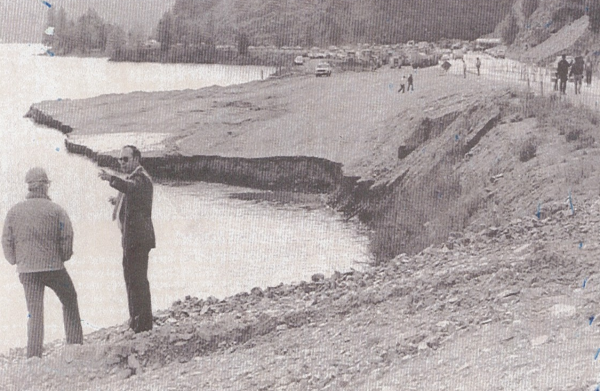
Contractor Scarsella Brothers, Inc., was placing fill in the lake in May 1990 to provide a base for an interchange at Higgens Point when the ground unexpectedly gave away, dumping a Caterpillar 631 scraper and a D-9 dozer and their operators into the water.

Both operators survived, but the dozer and scraper were barely visible and under about 90 feet of water.
ITD, the Idaho Department of Environmental Quality and several other agencies considered next steps. The tank of the scraper was able to be drained due to how it landed, but the dozer was inaccessible. State and federal agencies agreed that retrieval methods were too risky—both in terms of risk to personnel and to the stability of the slope underwater—and decided to abandon the equipment.
The proposed interchange was cancelled and replaced with plans for a parking lot.
THE FIRST LEAK
The dozer did not appear to leak product until 2000, when a sheen was noticed and determined to be coming from the dozer.
Booms were put in place to contain and capture the product, and ITD hired an engineering firm, CH2M Hill, to analyze field conditions and recommend options to resolve the current leak and capture future releases.
Seven options were put forth and evaluated for effectiveness, feasibility and cost. Both options to remove either the fuel tank from the dozer or the entire machine were rejected due to danger to personnel, the possibility of triggering a slide or the risk of releasing more product through recovery efforts.
ITD and DEQ opted for subsurface containment and collection. In 2001 a specially designed stainless steel hood was built and installed to cover the release site and capture any releases in a canister that could be emptied safely by divers. In 2002 a protective membrane was added to partially cover the dozer and further funnel product into the hood.

Eventually with no product coming to the surface, the booms were removed.
THE SECOND LEAK
Another leak in 2010 led to the removal of the hood, which needed maintenance, and was replaced with a larger membrane and a simple catchment system to receive and absorb any product.
That system remained in place, with no leaks detected until 2022.
CURRENT EFFORTS
Late December 7, ITD was notified of product coming to the surface in the general vicinity of the relic equipment.
The department placed floating booms to both contain the suspected diesel leak from the dozer and protect the shoreline. Dives determined that the equipment was still buried but that the older, first protective membrane had been disturbed, likely after being caught by a boat anchor. The other membrane looked to be intact.

ITD is again working with DEQ to pursue a specialized contractor to implement a quick and minimally invasive solution to capture and contain the leak. Once contained future, more permanent projects may be considered and developed.
Source: Idaho DMV